What Do You Need Before You Send Your First Email?
Start with three things:
An email marketing platform (Brevo, MailerLite, and Mailchimp are common starting points for Nigerian businesses, each with a workable free tier),
A verified sending domain rather than a generic free email address, and a clear sense of who you’re actually emailing and why. Sending from a free Gmail or Yahoo address for marketing campaigns looks unprofessional and performs worse on deliverability than sending from your own domain ([email protected]), since inbox providers trust an established, properly configured business domain more than a generic consumer email address.
Recommended read: Basics of Email marketing >>
Is Email Marketing Legal in Nigeria? What Does the NDPA Require?
This is the step most “how to start email marketing” guides skip entirely, and it’s not optional. Nigeria’s Data Protection Act (NDPA), passed in 2023 and enforced by the Nigeria Data Protection Commission (NDPC), sets real, binding requirements for marketing consent. Consent must be freely given, specific, informed, and unambiguous, and critically, the Act explicitly prohibits implied consent, meaning you cannot infer someone agreed to marketing emails just because they didn’t object, and pre-ticked opt-in boxes don’t count as valid consent either.
This isn’t a theoretical risk. Nigeria’s data regulator has already taken real enforcement action over exactly this kind of violation, fining a major platform tens of millions of dollars for processing Nigerian users’ data for behavioral advertising without properly obtaining explicit consent. Data subjects also have a specific legal right to object to marketing processing and to request their data be erased when it’s being used for direct marketing, rights you need a real process for honoring, not just a token unsubscribe link buried in fine print.
In practice, this means: every email address on your list needs a genuine, documented opt-in, someone actively checking a box or submitting a form specifically agreeing to marketing emails, not a name pulled from a purchased list, scraped from a website, or added because they made a single purchase without separately consenting to marketing.
How Do You Build an Email List the Right Way?
Given the consent requirements above, buying an email list is both a compliance risk and, separately, just bad practice, purchased lists convert poorly and damage your sender reputation with high bounce and spam-complaint rates.
Build your list through genuine opt-ins instead: a signup form on your website with clear language about what someone’s agreeing to, a lead magnet (a discount, a useful guide, early access to a sale) that gives people a real reason to subscribe, and a clear, separate checkbox at checkout if you also want to add purchasing customers to your marketing list, don’t assume a purchase equals marketing consent.
Every campaign needs a working, easy-to-find unsubscribe option too, not just because it’s good practice, but because it directly supports the objection and erasure rights the NDPA specifically grants.
How Do You Set Up Your Sender Reputation Correctly?
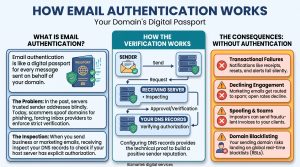
Before you send your first real campaign, set up SPF, DKIM, and DMARC records for your sending domain, technical authentication that tells inbox providers your emails are genuinely coming from you and haven’t been spoofed.
Skipping this step is one of the most common reasons new senders land in spam regardless of how good their content is, inbox providers weight sender trust heavily, and an unauthenticated domain starts with none.
New sending domains also benefit from a gradual warm-up: sending a small volume to your most engaged contacts first, then increasing volume over one to two weeks, rather than blasting your full list on day one.
Most established email platforms will guide you through this, and some automatically ramp new accounts to protect deliverability.
What Should Your First Few Campaigns Actually Be?
Rather than a single promotional blast, start with a welcome sequence, a short series of two to four emails sent automatically when someone subscribes, introducing your business, setting expectations for what they’ll receive, and offering a first-purchase incentive if relevant.
This is consistently one of the highest-performing email types, since it reaches people at their most engaged moment, right after they’ve actively chosen to hear from you.
If you’re running an online store, an abandoned cart sequence is worth setting up early too, a short series of follow-up emails for anyone who starts checkout but doesn’t complete it, since recovering even a modest share of abandoned carts often outperforms the effort of acquiring new traffic from scratch.
How Do You Know If Your Email Marketing Is Working?
Track open rate (how many people opened your email), click rate (how many clicked a link inside it), and, most importantly, conversion rate (how many actually completed the action you wanted, a purchase, a signup, a reply).
Open rate alone can be misleading, especially since privacy features on some email clients now inflate open rates artificially, click and conversion data give a much more honest picture of whether your emails are actually driving results, not just getting opened.
How Bizmartek Helps With Email Marketing in Nigeria
Getting the legal, technical, and strategic pieces right from the start avoids most of the problems that derail email marketing before it produces results.
Bizmartek sets up email marketing systems for Nigerian businesses correctly the first time, compliant list-building practices, proper technical authentication, welcome and abandoned cart sequences, and ongoing campaign strategy and copywriting, so you’re not learning NDPA compliance requirements and DNS records at the same time as trying to grow your business.
Bizmartek is registered with the Federal Republic of Nigeria (CAC BN: 8851229) and is tax compliant (TIN: 33549144-0001), with all payments made to a corporate account for full transparency.