How to Perform an SEO Audit for Your Website


Why your SEO needs constant attention
It is honestly amazing how many small business owners treat SEO (Search Engine Optimization) as the lowest priority on their marketing checklist. There is a pervasive myth out there: “As long as my website is launched and online, the SEO will eventually fix itself,” or “My developer installed an SEO plugin, so I’m good to go.”
If you have ever found yourself thinking this way, I need you to pull up a chair and listen closely.
Unfortunately, this could not be further from the truth. Believing that SEO is a one-time task is like buying a brand-new car and assuming you never have to change the oil, rotate the tires, or put fuel in it ever again. Sure, it will run fine for a little while. But eventually, it will start making strange noises, it will slow down, and one day, it just won’t start at all.
Related: How to master Search Engine Optimization (SEO) for your business.
Your website works the same way. The digital landscape is not static; it is a living, breathing, and rapidly changing environment. If you are not actively maintaining your position, you are effectively moving backward.
Today, I want to break down exactly why SEO is never “done” and why resting on your laurels is the fastest way to lose visible revenue for your small business.
1. Constant Algorithm Updates
Let’s start with the biggest player in the room: Google.
Despite the rise of competitors and new tech, Google still controls the lion’s share of organic search traffic on the web. When Google sneezes, the rest of the internet catches a cold.
Here is the reality: Google does not just set its ranking algorithm and walk away. They are obsessively tweaking, testing, and updating it. According to industry data, Google makes thousands of minor changes to its search algorithm every single year, along with several major “Core Updates” that can completely reshape search results overnight.
Why does Google change so much?
Their goal is to provide the absolute best, most relevant answers to users. As people change how they search (using voice search, asking more complex questions, using mobile devices more than desktops), Google has to adapt its systems to understand that intent.
If your last SEO effort was when you launched your website two years ago, you are optimizing for a version of Google that no longer exists.
What worked in 2023 might actually hurt you today. For example, years ago, you could stuff a page full of keywords and rank well. Today, Google’s helpful content updates will penalize you for that, preferring content genuinely written for humans, not just bots.
If you stop at what you have done and neglect ongoing SEO, the rug can be pulled out from under you without warning. You might wake up one morning to find your main traffic-driving keyword has dropped from position #1 to position #15, all because an algorithm update decided your content was no longer the “freshest” answer.
2. Your Competitors Are Not Sleeping (And They Want Your Spot)
This is perhaps the most critical point to understand: SEO is a zero-sum game.
For every winner on the first page of Google, there has to be a loser who got bumped off. There are only ten standard organic spots on that first page. If you currently hold spot #3, there are hundreds of other businesses actively trying to take it from you.
You might think, “My business is unique, I don’t have many competitors nearby.”
You need to differentiate between “real life” competitors and “SEO competitors.”
Real-life competitors are the businesses you know about—the shop down the street or the other major service provider in your city.
SEO competitors are anyone ranking for the keywords you want, even if they aren’t a direct business rival. It could be a massive industry blog, an international company, or a directory site. They are all stealing clicks that could have gone to you.
While you are thinking “SEO is done” and focusing elsewhere, these competitors are:
Analyzing your website to see which keywords are bringing you traffic.
Creating newer, better, more in-depth content than yours to outrank you.
Building new backlinks to increase their site’s authority over yours.
It is a dog-eat-dog world on the search engine results pages (SERPs). If you are standing still, you are an easy target. You have to constantly be on the offensive—finding new keyword opportunities, updating your old content, and implementing new strategies—just to maintain your current position, let alone grow it.
3. The SEO Landscape Has Changed Forever
I mentioned standard algorithm changes earlier, but recently, we have seen a seismic shift that goes beyond just standard updates. The entire way people use the internet to find information has fundamentally changed over the last few months.
We have entered the era of Artificial Intelligence.
With the rise of platforms like ChatGPT, Claude, and Perplexity, user behavior is shifting. People are no longer just typing “best plumber in Lagos” into a search bar and clicking ten blue links. They are asking AI bots conversational questions: “Find me a reliable plumber in Lagos who is available on weekends and has good reviews for fixing broken pipes.”
The Rise of AI Overviews (SGE)
Even Google has had to adapt to this by rolling out AI Overviews (formerly known as Search Generative Experience or SGE). Now, when a user asks a question, Google often provides a complete AI-generated answer right at the top of the search results.
This means users can often get the answer they need without ever clicking on a website.
This is a scary prospect for small business owners who rely on that click traffic. If your SEO strategy is still stuck in 2022—relying purely on basic keywords—you are already behind. The new game is about “Generative Engine Optimization” (GEO).
You now need to position your content so that these AI models view you as the authority. You want ChatGPT to recommend your business when someone asks it for advice. You want Google’s AI to cite your article as the source of its answer.
This requires a completely different approach to creating content on your site—one focused on deep expertise, clear answers, and high-authority trustworthiness. You cannot “set and forget” this; it’s a brand-new frontier that requires active participation if you don’t want to become invisible to the next generation of searchers.
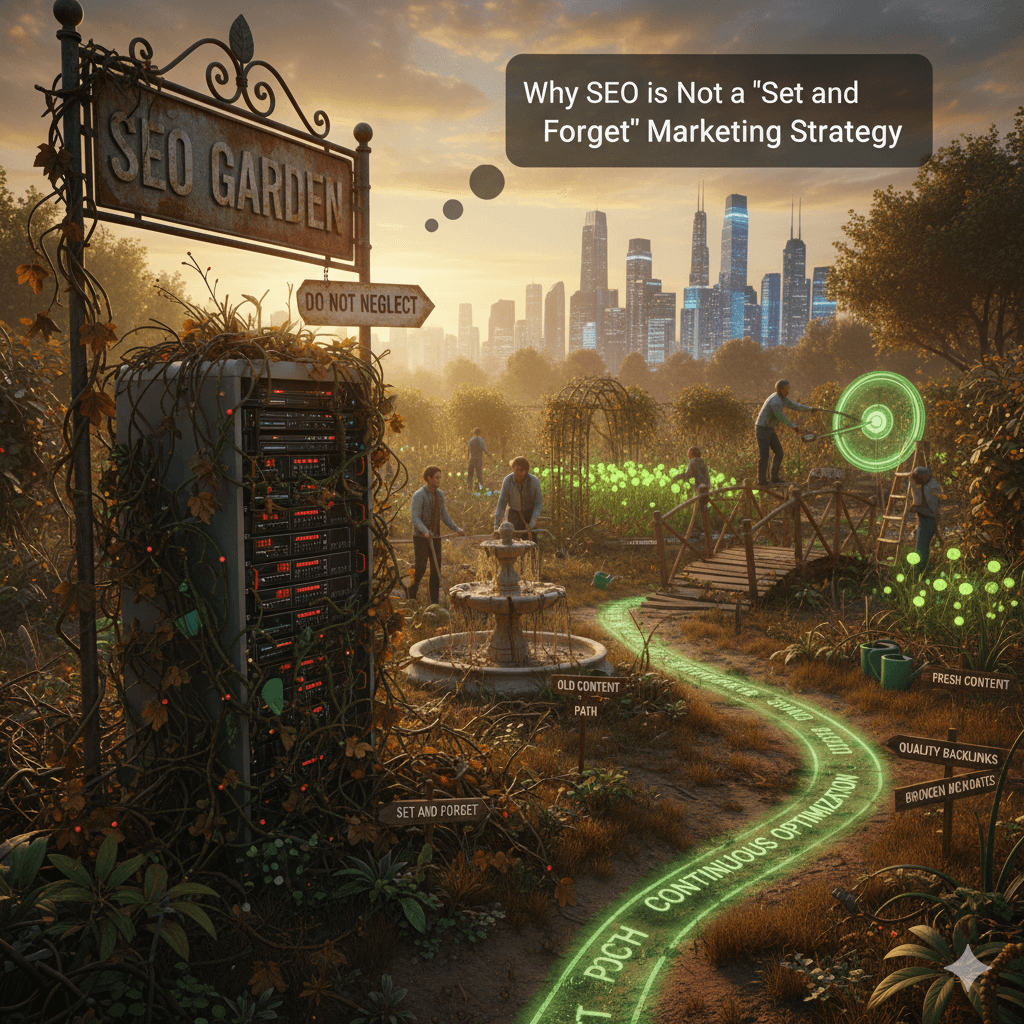
There are many other reasons why SEO is never truly finished—technical issues crop up, old content “decays” and needs refreshing, and new opportunities arise daily—but these three are the most urgent.
If you launched your website and haven’t paid real attention to your SEO since, now is the time to rethink that strategy. The digital world didn’t stop moving just because you finished your website project.
Does all of this sound overwhelming? Does terms like “algorithm updates,” “SEO competitors,” and “AI overviews” sound like gibberish to you? That’s okay—you are supposed to be running your business, not spending 10 hours a week reading SEO news.
That is where we come in.
If you want your website to stop collecting digital dust, outrank your hungry competitors, and start showing up in standard Google searches and new AI platforms so customers can actually find you, you need a partner who stays ahead of these curves for you.
Reach out to us at www.bizmartek.com.ng.
We will arrange a free consultation session with you where we analyze exactly where you are currently, what opportunities you are missing, and how we can help you get to where you want to be.
Don’t let your competitors snatch your customers while you sleep
Ready to Grow Your Sales Online?
Stop guessing. Get proven digital marketing strategies that bring in real customers.
Free to start • No credit card required