
How to Find Customers for Your Business: 10 Proven Strategies

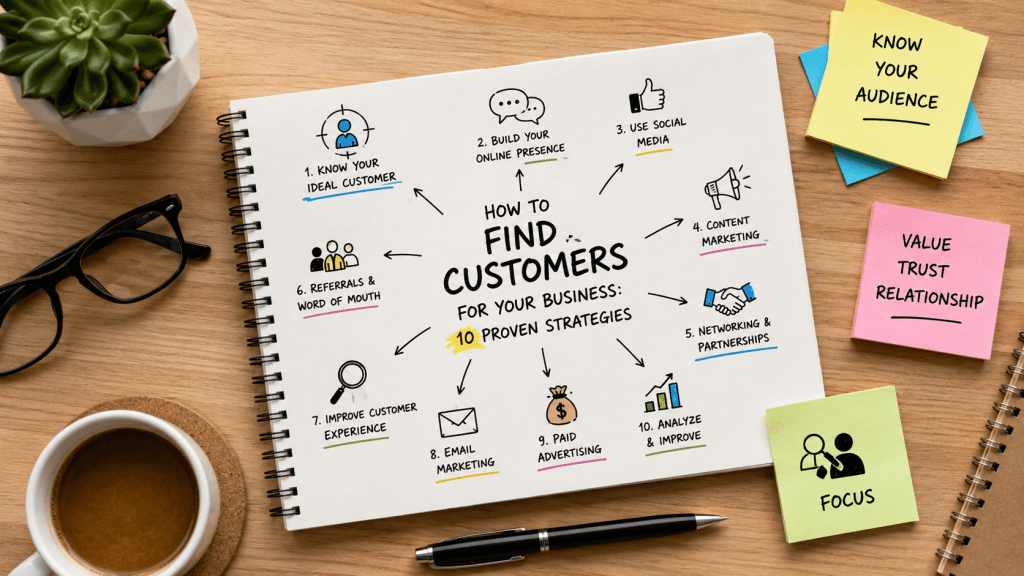
Key Highlights
- Get 10 practical customer acquisition strategies backed by real research, not guesswork
- Learn why referrals remain one of the highest-trust ways to win new customers
- Get a diagnostic framework for figuring out exactly where your current marketing is breaking down
- Understand why “more marketing” isn’t always the right answer
- Knowing exactly who you’re selling to makes every other strategy easier and cheaper to execute
- Recommendations from people we know remain among the most trusted forms of advertising, well ahead of paid ads
- SEO and content marketing take longer to work than paid ads, but tend to produce more durable, lower-cost customer acquisition over time
- If customers aren’t coming, the fix depends on exactly where they’re dropping off, visibility, interest, trust, or retention, not just “spend more on ads”
- The businesses that grow consistently treat customer acquisition as a repeatable system, not a rotation of random tactics
Having a great product or service is only half of building a successful business. The other half is getting the right people to discover you, trust you, and eventually buy from you, and that’s where most small businesses actually struggle. The good news: finding customers doesn’t require a huge advertising budget. It requires knowing who you’re looking for and using the right combination of channels consistently.
1. Know Exactly Who Your Ideal Customer Is
Before looking for customers, you need to know who you’re actually looking for. One of the most common mistakes businesses make is trying to sell to everyone. Instead, define your ideal customer specifically: who needs what you sell, what problem they’re trying to solve, where they live, what they can afford, which platforms they actually use, and what would make them choose you over a competitor.
The U.S. Small Business Administration similarly recommends identifying your ideal customer and clarifying the problem your business solves before choosing where to focus your marketing effort. The goal isn’t to reach everyone; it’s to reach the people most likely to actually need and value what you offer.
2. Make Your Business Easy to Find on Google
Think about the last time you needed a product or service; you probably searched for it. Your potential customers are doing exactly the same thing: “digital marketing agency in Abuja,” “best wedding photographer in Lagos,” “where to buy skincare products in Nigeria.” If your business doesn’t appear when people search for what you offer, you’re losing customers to whoever does show up instead.
Google’s own guidance recommends creating useful, well-organized, people-first content, and using the words your audience is actually likely to search for throughout your site. For businesses serving a specific location, keeping your business information accurate and consistent across every platform customers might use to find you matters just as much as the content itself.
3. Use Social Media to Build Visibility
Social media shouldn’t just be a place to post product photos, it should help potential customers discover your business, understand what you offer, and build trust before they ever buy. Depending on your audience, that might mean Instagram, Facebook, TikTok, LinkedIn, WhatsApp, or X, but you don’t need to be everywhere. Choose the platforms where your actual potential customers spend their time, and create content that answers their questions, demonstrates expertise, and gives people a reason to remember your brand.
Consistency matters more than volume here. You don’t need to post ten times a day, you need to consistently give potential customers reasons to discover, understand, and trust your business over time.
4. Ask Your Existing Customers for Referrals
You don’t always need to find completely new people, your existing customers may already know people who need what you sell. If someone’s had a great experience with your business, ask them to recommend you, whether through a simple incentive (“refer a friend and get 10% off”) or just a direct ask.
This works because recommendations from people we already know carry real, measurable trust. Nielsen’s global Trust in Advertising research has consistently found that recommendations from people consumers know personally rank among the most trusted forms of advertising, well ahead of branded ads. A Nigeria-specific study on trust and referral behaviour in Nigeria’s telecom sector found the same underlying pattern locally: trust has a strong, measurable relationship with word-of-mouth advocacy and customer referral, reinforcing that this isn’t just a global finding, it holds specifically in the Nigerian market too. Your happiest customers can become one of your most valuable, and cheapest, acquisition channels.
5. Create Content That Solves Problems
One of the easiest ways to attract potential customers without constantly selling is to teach. A skincare brand doesn’t only need to post “buy our products”; it can post “5 reasons your skin may feel dry.” A digital marketing agency can write “why your Facebook ads aren’t converting.” This kind of content attracts people who already have the problem you solve, and gives them a chance to experience your expertise before they ever pay you.
Google’s current guidance specifically recommends creating content that’s helpful, reliable, and made primarily for people, not content produced simply to manipulate rankings. Create what your potential customers are actually asking, not just whatever’s easiest to post.
6. Run Paid Advertising
Organic marketing takes time. If you want your business in front of a specific audience faster, paid advertising, Google Ads, Facebook Ads, Instagram Ads, TikTok Ads, LinkedIn Ads, can help. But putting money behind an ad doesn’t automatically produce customers on its own. Your campaign still needs the right audience, offer, creative, landing page, and tracking working together.
Before launching, get clear on what the campaign should actually achieve, sales, leads, visits, or another measurable action, and set up conversion tracking to match. Paid advertising increases visibility; strategy determines what actually happens with that visibility once you have it.
7. Build Partnerships With Complementary Businesses
Another business may already have access to the exact customers you want. A photographer partnering with a makeup artist, a fashion brand with a jewelry business, a web designer with a copywriter, these partnerships work because they serve a similar audience without directly competing with each other. Referral partnerships, collaborations, bundles, and joint campaigns let both businesses reach people already interested in what they offer, as long as the arrangement genuinely benefits both audiences rather than just becoming two businesses promoting to each other’s followers.
8. Go Where Your Customers Already Are
Sometimes the fastest way to find customers is to stop waiting for them to come to you. If your customers attend trade fairs, conferences, community events, or professional associations, show up, talk to people, and understand their actual problems. This matters especially for high-value services where customers typically need several conversations before deciding, and it creates natural openings for referrals and partnerships that pure advertising can’t replicate.
9. Make Your Business Look Trustworthy
Getting attention is one thing; getting someone to trust you enough to actually buy is another. Your potential customer is asking, consciously or not: is this business legitimate, will I actually receive what I paid for, are these reviews real? Give them clear reasons to say yes: customer reviews, testimonials, case studies, your team, your process, clear contact information. Trust matters most on a first purchase, when a customer has no prior experience with you to fall back on, don’t just tell people you’re good, show them evidence.
10. Don’t Just Find Customers, Build a System
This is where many businesses go wrong: Instagram one week, Facebook Ads the next, then silence, then TikTok, then a discount push, then silence again. Finding customers consistently requires a repeatable system rather than a rotation of disconnected tactics, something like SEO, website content, lead, follow-up, sale, referral, or social media, paid ads, landing page, WhatsApp, follow-up, sale. The exact system depends on your business, but the principle holds: once you understand where customers actually discover you, what builds trust, and what gets them to buy, marketing stops being random activity and becomes a predictable process.
What If You’re Not Getting Customers Yet?
Before increasing your ad budget, stop and diagnose the actual problem. If the right people aren’t seeing your business, that’s a visibility problem, fixable through SEO, social presence, partnerships, or advertising. If people are seeing you but not showing interest, that’s a messaging or offer problem; they may not understand what you offer or why it matters to them. If people are interested but not buying, look at pricing, trust signals, and your sales process; the marketing may be working fine while something later in the journey causes drop-off. And if people buy once but never return, that’s a retention problem, not an acquisition one, more new customer marketing won’t fix it.
More marketing isn’t always the answer. Sometimes the real problem is what happens after marketing brings someone to your door.
How Long Does It Take to Get Customers?
There’s no universal timeline; it depends on your industry, offer, price point, channel, and how much trust your buying decision requires. A low-cost product might convert from a single social post; a high-ticket service may need weeks of content, conversations, and research before someone decides. SEO specifically tends to take longer than most businesses expect, changes to a website can take anywhere from hours to several months to show impact in search results, so don’t judge your SEO effort based on a few days. Track the full journey instead: visibility, enquiry, lead, conversion, to see exactly where customers are dropping off and what actually needs fixing.
Conclusion
Finding customers isn’t about discovering one secret trick; it’s about consistently putting your business in front of the right people, giving them a genuine reason to pay attention, building enough trust for them to consider you, and making it easy to actually buy once they’ve decided. You don’t need every channel at once. Start by understanding your ideal customer, choose one or two channels where they’re already active, create genuinely useful content, collect real proof from existing customers, and track what’s actually generating enquiries and sales, not just what feels productive.
For Nigerian businesses specifically, this matters more than it might elsewhere: research shows the leading cause of small business failure in Nigeria isn’t a bad product; it’s a lack of market visibility, not enough of the right people ever finding out the business exists. That makes the strategies above less of an optional growth tactic and more of a survival fundamental. If you’re not sure which part of your customer journey is actually breaking down, that diagnosis, more than any single new channel, is usually the right place to start.